Prague
CZ
Explore Prague from Old Town Square and Charles Bridge to the Castle, Jewish Quarter and Vltava, with Czech food and practical walking routes.
Photos
Prague is easiest to understand by following the Vltava. The Old Town and New Town occupy one bank; across the river, Malá Strana climbs towards Hradčany and Prague Castle. Bridges connect these areas, but the distances, slopes and museum visits make a difference to how much you can comfortably see in a day. Two full days allow a useful first introduction; a third gives you room for the Jewish Quarter, parks and streets beyond the busiest sightseeing route.
The historic centre has been on the UNESCO World Heritage List since 1992. Its importance is not confined to a single monument: medieval street patterns, Gothic churches, Renaissance buildings and later architecture remain part of a working city. Look above shopfront level as you walk, and allow time for courtyards and smaller streets between the major sights.
Old Town Square and the Astronomical Clock
Old Town Square is a practical starting point. The twin towers of the Church of Our Lady before Týn rise behind the houses on its eastern side, while the Old Town Hall and its Astronomical Clock draw visitors to the opposite side. The contrast between church towers, civic buildings and compact streets is more revealing than a quick stop for a photograph.
The Astronomical Clock was installed in 1410, with clockmaker Mikuláš of Kadaň responsible for its mechanism. It is not simply a conventional clock face: the astronomical dial and the calendar dial below it express different ways of organising time. The frequently repeated story that Master Hanuš was blinded to prevent him from building another clock belongs to legend. Hanuš worked on the clock later; he was not its original maker.
Give the square a second look after walking through the surrounding streets. A quieter approach to sightseeing is to alternate a major attraction with a short detour, rather than following the crowd continuously from the clock towards the bridge.
Charles Bridge and Malá Strana
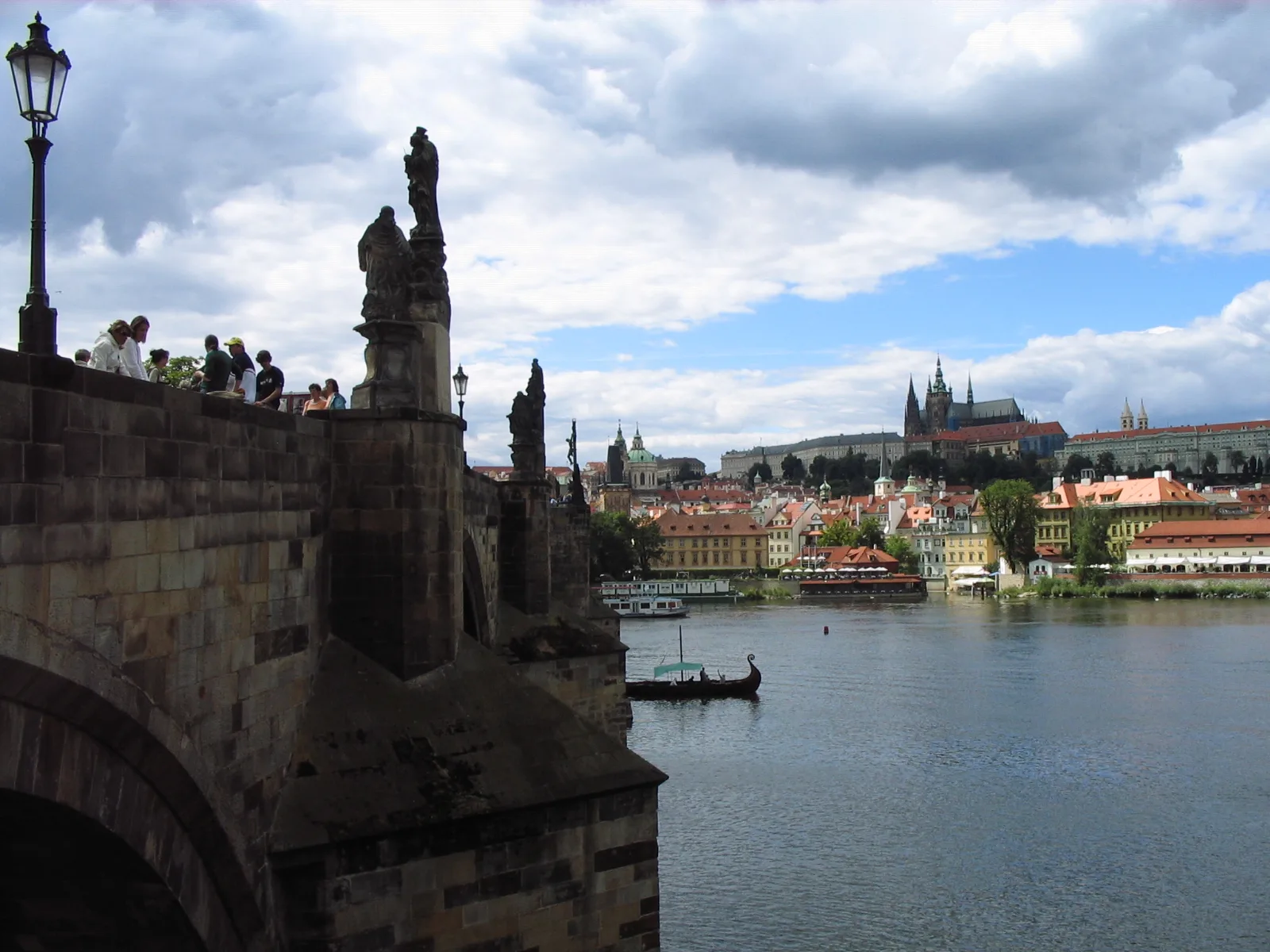
Charles Bridge began under Charles IV in 1357 and was completed in 1402. The bridge, its towers and the later sculptural decoration belong to different stages of Prague's history. From the crossing, the river and the Castle skyline explain the relationship between the two banks particularly well.
For a first visit, cross from the Old Town towards Malá Strana and continue on foot towards the Castle. An early start is worth considering if your priority is photography or an unhurried walk, although no hour guarantees an empty bridge. Pause without blocking the narrow pedestrian flow, and take photographs from the riverside too: the side view shows the arches and the bridge's setting better than the view along its crowded deck.
Malá Strana is a separate part of the visit, not merely the approach to the Castle. Its streets, squares and changes in elevation reward a slower pace. Before starting the uphill section, consider a riverside break around Kampa. Comfortable shoes matter here: cobbles and steep streets are part of the route.
Prague Castle, Hradčany and Golden Lane
Prague Castle is a complex of courtyards, religious buildings and historic interiors rather than a single castle room to tick off. St Vitus Cathedral is the main architectural landmark, but a visit can also include the Old Royal Palace and Golden Lane. Decide which interiors interest you before buying a ticket; access to grounds and access to individual buildings are not the same thing.
Golden Lane developed after the northern fortifications were built in the late fifteenth century. Its small houses offer a different scale from the monumental courts nearby. Allow time to move between these contrasting spaces instead of attempting every interior on a tight schedule.
Hradčany Square outside the main entrance is worth including in the walk. The supplied photograph records an earlier visit, including scaffolding visible at the entrance; it should not be treated as a report of present construction work. Check the Castle's official website for current ticket arrangements, closures and visitor rules.
Josefov and Jewish Prague
North of the central Old Town, Josefov adds a different historical perspective. A visit to the Jewish Museum in Prague and its sites should be planned as a substantial part of the day, not squeezed into a few spare minutes. The Old Jewish Cemetery and synagogue exhibitions are places of religious heritage and remembrance as well as architectural interest.
The Old-New Synagogue dates from the late thirteenth century and remains an active synagogue. Check the current admission arrangements for the exact sites you want to enter, and follow their photography and conduct rules. A museum ticket should not be assumed to include every building in the neighbourhood.
New Town, shopping streets and everyday Prague
Wenceslas Square introduces a broader, more urban setting than the Old Town lanes. Buildings from the nineteenth and twentieth centuries, shops, hotels and public life give this part of the city a different character. Include it in your route if you want to see more than Prague's medieval image.
The photographs also show a tourist sightseeing vehicle and the façade of Černá růže. These are details of the city encountered on earlier visits, not endorsements of a particular operator or a guarantee that photographed shops still trade there. When booking a vehicle tour, establish its actual route, duration and price before paying.
The Vltava, Letná and Vyšehrad
A river walk provides a useful break between interiors. Bridges, embankments and boats create changing views of the same city, and the supplied river photograph shows leisure boating on the Vltava. Boat and pedal-boat services depend on the operator, season and conditions; check availability locally rather than building an entire day around an assumed departure.
For an elevated view, Letná Parks overlook the river and its bridges. Alternatively, head south to Vyšehrad, a rocky promontory with gardens, the Romanesque Rotunda of St Martin, the Church of Sts Peter and Paul and the national cemetery. Choose one of these extensions for a first short stay; both deserve more than a rushed photograph.
Czech food: read the plate as well as the menu
Czech cuisine makes extensive use of sauces, roasted meat, cabbage and dumplings. Bread dumplings and potato dumplings are different accompaniments, not interchangeable descriptions. Svíčková pairs beef with a creamy sauce and dumplings; roast pork with cabbage is another familiar combination.
The meal in the gallery shows roast poultry, cabbage and sliced dumplings. It is a useful illustration of this style of cooking, but the photograph alone does not establish the restaurant or the exact menu name. Read the menu for ingredients and allergens, especially in sauces and dumplings, and compare the full meal price rather than only the headline price of a main course.
Getting around and planning two days
Use the official PID ticket guidance for metro, tram and bus travel. Paper tickets that require validation must be validated when first boarding or entering the metro paid area; mobile tickets have their own activation requirements. Check validity before travelling. For the airport connection, PID describes trolleybus 59 to Nádraží Veleslavín, followed by metro line A. Consult current journey information for disruptions and alternatives.
Day one, suggested route: Old Town Square and the clock, surrounding lanes, Charles Bridge, Malá Strana, then Prague Castle and Hradčany. Begin early and reduce the number of Castle interiors if you want a relaxed pace. This route involves an uphill section; public transport can help you approach the Castle from higher ground.
Day two, suggested route: Josefov in the morning, followed by Wenceslas Square and a meal, then a river walk or a park visit. Choose Letná for bridge views or Vyšehrad for a longer historical and green-space stop. Travellers with limited mobility should check attraction-specific accessible routes rather than assume the historic centre is uniformly step-free.
Prague during Advent
Seasonal stalls change the atmosphere of the central squares. The Old Town Square Christmas Market has its own article with edition-specific dates and official confirmation. Do not assume that every Prague market shares those dates: Wenceslas Square and other venues are separate events. Browse events in Prague when planning a seasonal visit.
The gallery combines photographs from earlier visits. They illustrate Prague's architecture, streets, river and food, not the current condition of every venue or a single dated itinerary.